| In the fall of 1960, when I first
arrived Scripps Institution of Oceanography, several guys had hydrofoil
paipo boards. As I recall, they were Gaylord Miller's design. Anyhow,
I built a copy as my first wave-riding vehicle (not counting my camping
air mattress that I went out with for my first few adventures). But the
combination of learning both to surf and to ride a hydrofoil board at the
same time was just too big a step for me, so I soon gave up and bought
a used Yater surfboard.
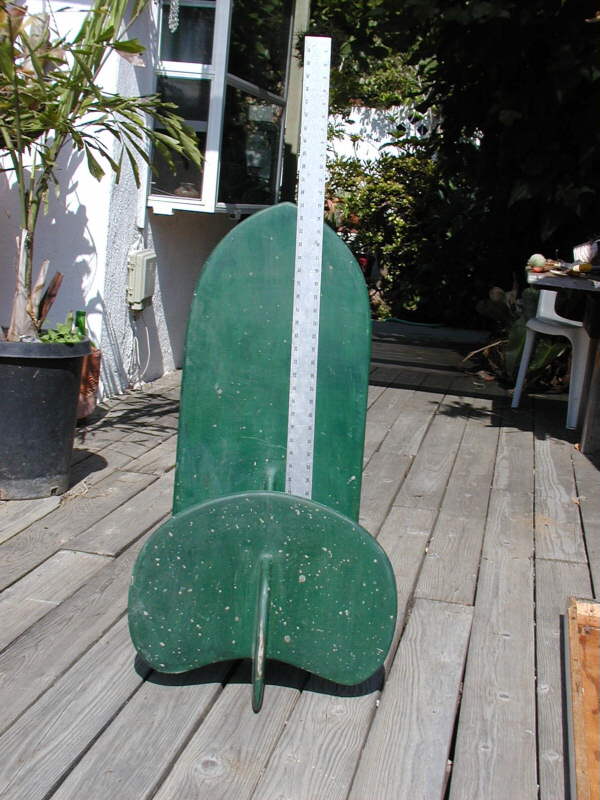
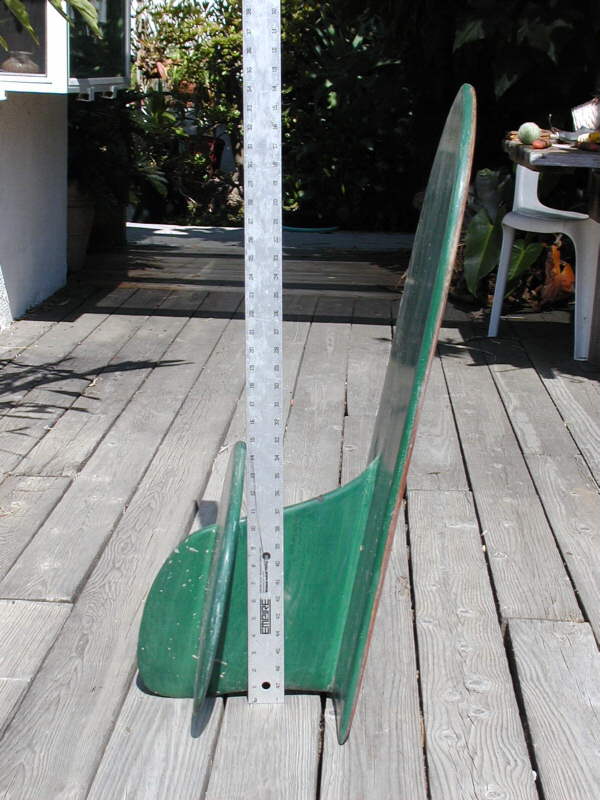
Later I gave my hydrofoil board to Steve Lis and Stan Pleskunas to play with back around 1969-70. I contacted Stan about 5 yrs ago, but he no longer had any idea where it went. So it was great to run into Niel (the current owner of the board in the photos) in Costco. One of the topics of conversation was hydrofoil wavecraft and Gaylord Miller's design at Scripps Institution of Oceanography back in the 60's. He mentioned that he had one of those boards (as documented in "Scripps Stories -Days to Remember" [see reference below] )... but that it hadn't been used in years. Neil didn't know for sure when
it had been built, but he does remember that it was prior to 1965 as that's
when a friend of his (who had received his Ph.D. and was leaving Scripps)
gave it to him. Anyhow, Saturday I finally made it over to his place and
got a couple of photos of it (which I've
Terry Hendricks
(Click on pic for a larger view.)
Kuhns, Kittie Kerr and Betty Shor, eds. Scripps Stories: Days to Remember in Celebration of 90 Years. (La Jolla, Calif.: Scripps Institution of Oceanography, University of California) San Diego, CA 92093 October 1993 S.I.O. Reference #93-35 It is a series of stories,
each told by someone who worked (or works) at Scripps Institution of Oceanography,
"I started working at SIO/IGPP in November of 1960..." After I worked hereOne thing I found interesting in reading this is that Don Miller's description seems to at least to be consistent with my contention (and recollection) that because of the sensitivity of the board to pitch angle (when used as a hydrofoil), it was essentially ridden not as a true hydrofoil, but rather as a board with a separate planing surface below the board proper: "...On big waves Gaylord's device would lift his entire 200-pound-plus bodyI hope this helps. I'll let you know when I get more information about the book from my contact. Terry Hendricks
|