| Are
they called fins or flippers? Fins or skegs? Back when I started riding
the waves (1960s) life was simple: swim fins were called flippers and
board
fins were called skegs. These days both are called fins. Well... this
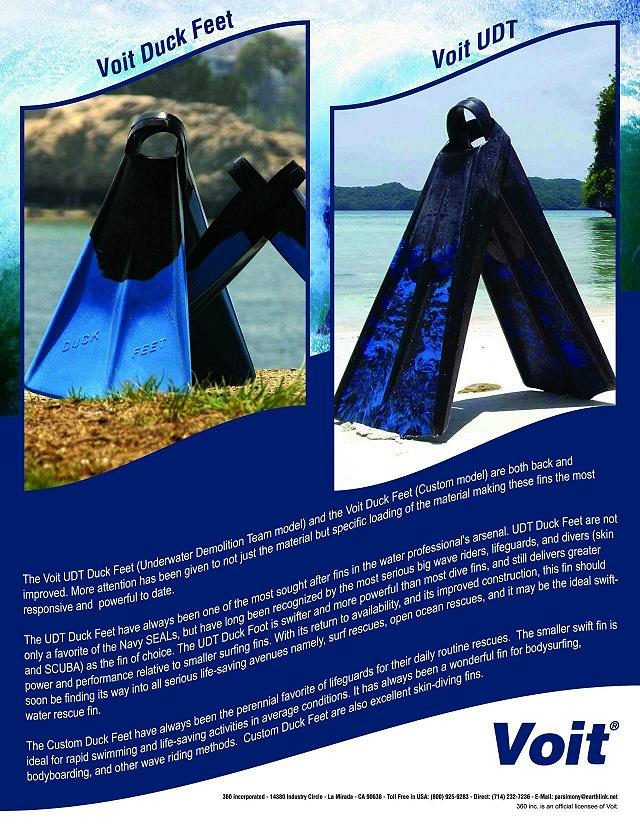
page is about flippers. Information on skegs is here. For starters, which swim fins are for you or me? No correct answer! To paraphrase Paul Gross, "What kind of swim fins should I use with a mat (or paipo)? Everyone has a unique set of needs, so no one size or design fits everyone." (See more relevant swim fin information at p. 30 of the 4th Gear Flyer Riders Guide, as of Nov 5, 2021.) A good overview on swim fins is provided courtesy of eBodyboarding.com. Read another useful review by The Little Pink Shop at Croyde Bay [my link to the PDF version here]. Flexspoon has some information on Deet's reformulated UDTs and the modifications made by George Greenough. More on the UDTs [PDF version, 500k]. Another water enthusiast passed along his suggestions for trimming down UDTs for increasing power & flex and decreasing discomfort. For more information on swim fins see the Wikipedia article. UDTs are now being distributed by Voit (for more info call Ph:714-232-7227 Ext 2, or see the surfmatters.blogspot). An interesting article on the history of swim fins (and paddling gloves) appeared in the on-line bodysurfing magazine, Swell Lines: Swimming Propellers: History of the Swim Fin. Stock, Kyle. (2014, April). Swimming Propellers: History of the Swim Fin. Swell Lines: The Bodysurfing Magazine, 1(2). Retrieved April 21, 2014, from swelllinesmag.com/2014/04/18/455/ (and a PDF when the link swerves away). Table of Contents/Shortcuts Did you know that Benjamin Franklin is credited with inventing the flippers and paddling gloves? Even earlier, in the 15th century, Leonardo Da Vinci experimented with various devices to improve the human physical condition: wings, vehicles and swim fins. Read the interesting table of analysis on the relative thrust performance of various surf/swim fins (and web gloves). The methodology, as posted to AS, is posted here. By Alt.Surfing's "sdbchguy." Project Swin Fin Metrics: How long are your swim fins, how wide, and how much do they weigh? Can you slip your foot into the pocket? This project is just starting up... measurements are welcome (to the 1/8th of an inch). See a very basic table of data here. Complete the Swim Fin Metrics Form. |
|
Here are links for some "flippers" or swim fins
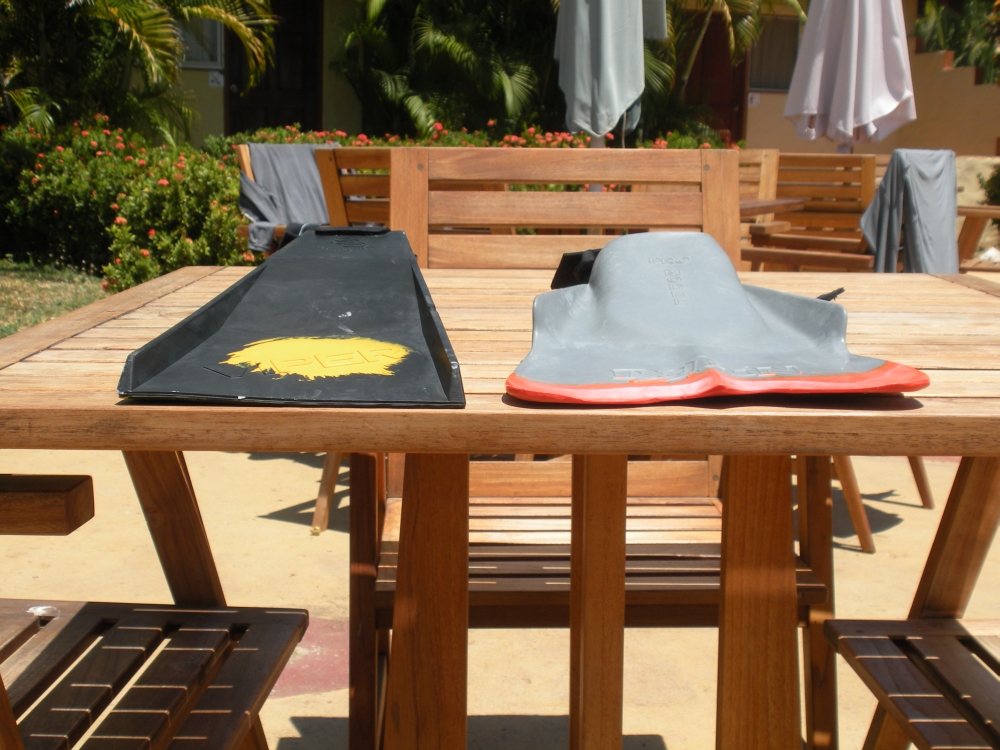
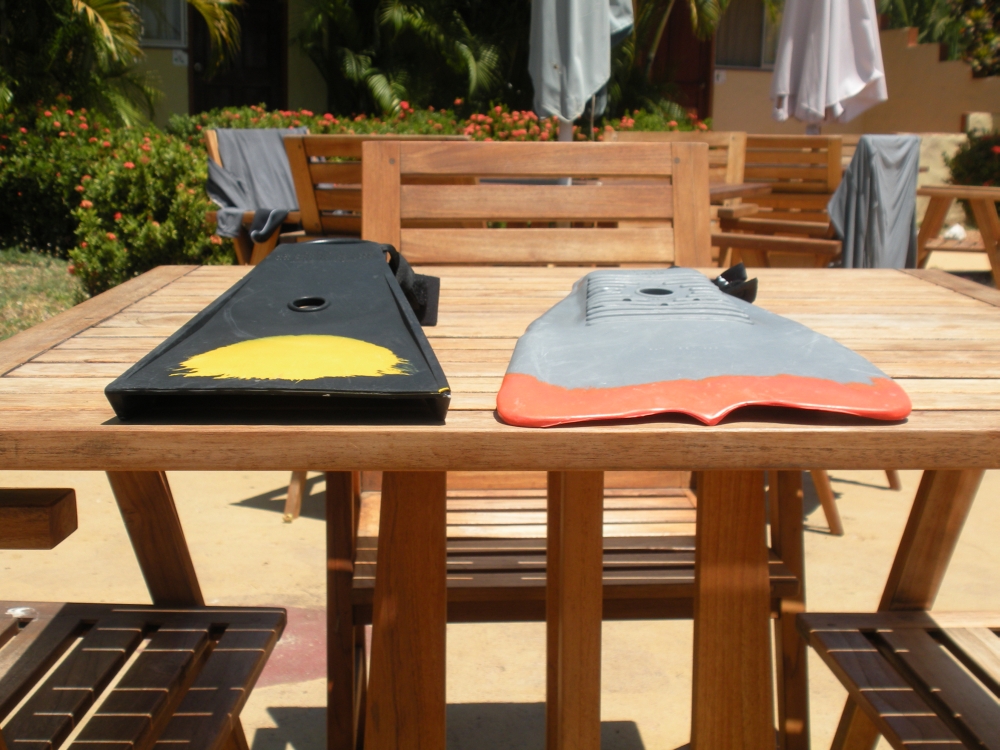
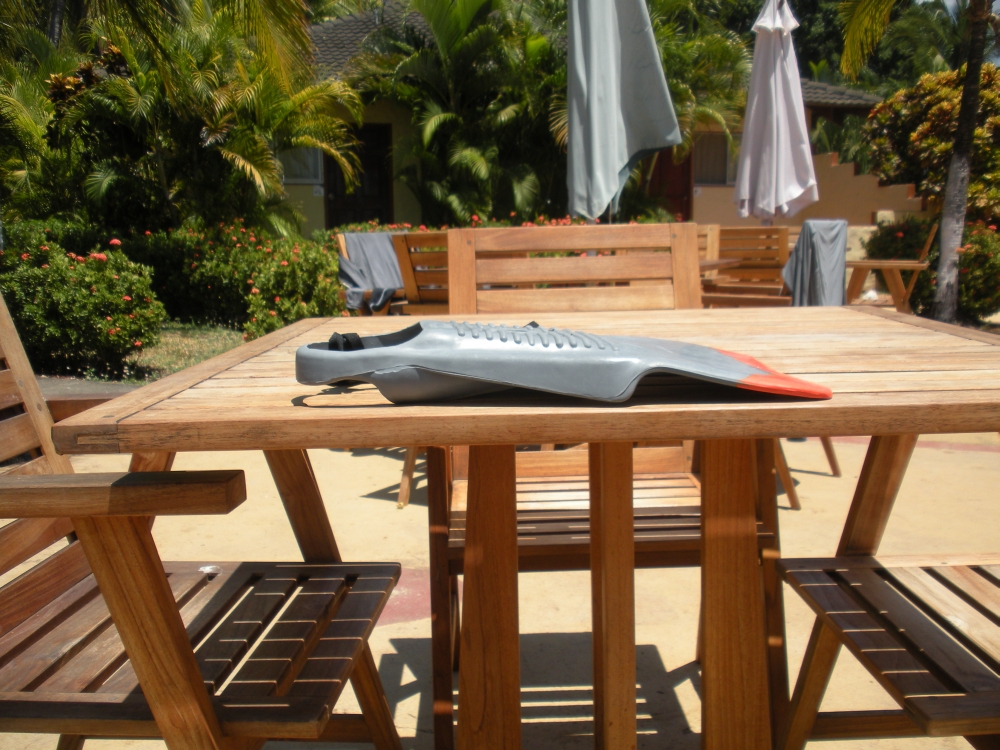
My Journey Through Flippers. I was a long time user of Churchill's (when they were still made of rubber and had a more flexible blade). For years I searched the used fins racks for old Churchills, often buying off the rental bins. Eventually these venerable Churchills were no longer to be found and my collection was cracking and dry rotting from use and old age despite fresh water rinses after every session. After buying, borrowing and testing many, many different fins I have settled on three models: the Viper V-5 Flex (Orange Dot) and V-5 (Yellow Dot) stiff blade models for warm water and Hydro Techs for cold water (to accommodate 4mm-7mm of fin socks). Ultimately, the "best fins" for any user depends upon many factors, including but not limited to foot size and shape, surf style (bodysurfing, prone boarding, drop knee or kneeboarding), blade flexibility, blade design, floating/non-floating, weight, and surge thrust. Also, feel free to visit my "rant page" on trying to find a pair of fins that didn't wreck my ankles or squeeze my feet. Hopefully by sharing my experiences others will have a better idea on what is best for them. Update #1 for November 2013: A new swim fin is in my quiver, the DaFin. I had been waiting awhile to actually give this fin a test drive in the water rather than spending another bunch of dollars on an unsatisfying fit or function. Although the Vipers will be my go-to swim fin the DaFin is a nice addition and because of its wide foot pocket will better satisfy my need for a cool-cold water swim fin (relative to the heavy and wide bladed Hydro Techs). [Notice: I have worked out a distribution deal to supply DaFin swim fins -- proceeds will defray the costs for opeating the MyPaipoBoards.org site -- I will only endorse & sell swim fins that I actually use. Contact me at: paipodude@mypaipoboards.org] Update #2 for November 2013: Another new formulation swim fin will NOT be in my quiver -- the Vektor Viper. I recently attempted to try on a pair of large yellow Vektor Vipers but could not come close to putting my foot into the foot pocket. Apparently the space between the foot pocket and ankle strap has been narrowed. I was also quite amazed at the flexibility in the stiff blade yellow model's blade relative to the regular Viper Yellow Dots -- the outer blade ridge stiffeners actually bend very easily. How this translates into use in the water remains to be seen... especially for somebody who can not even place a foot into the pocket. I also noticed that the ankle strap is much more stiff and rigid than the longtime Yellow and Orange Dot models. Update #3 for 2014/2015: Some time during the past 12 to 18 months the DaFin Pro Classic has become my fin of choice. The transition really took off during my trip to Puerto Rico in January 2014, after switching out my "underperforming" Vipers for my pair of DaFin swim fins. After using them at a couple of different surf breaks in the PRNW the transition had become complete. I probably used my Vipers a couple of times in Costa Rica during March and June 2014, but it became obvious to me that the DaFin was my preferred fin. A big plus is being able to use the same size in warm tropical and cool/cold waters of summertime N. Oregon. I would probably step up one size if planning to use DaFins in cold water where 5 to 7mm of fin socks would be needed. Another advantage of the DaFin over the Vipers is weight -- DaFins weigh nearly have as much! Both DaFin and Vipers are floaters. Update #4 for 2025/2026: John Hughes, introduced me to DaFins Pro Classic during Nov/Dec 2013 (see above). Twelve years later in Nov/Dec 2025 he introduced me to the DaFin Flex model. As he was on medical restrictions I was able to use his fins on a few different sessions. He asked me how I liked him and my answer was, "I bought a pair!" What a nice feel: easy enough to put on my feet and felt great in the water. The waves were modest, all under 4 ft. and it was easy to paddle out, current was light to nil. But they felt flowing and powerful in the water. After using my standard DaFin Pro Classic ("stiff blade"), I was ready for the Flex model--these will get a trials testing in PR in Jan 2026. NOTE: The sizing seems to run small: I wear a L for DaFin Pro (classic fin) but need an XL for DaFin Flex. |
|
Foot Pocket Entry Comparison Between a DaFin Pro Classic on Top of a Yucca Long Blade Ultra Soft Flex (Both Foot Size Large) |
|
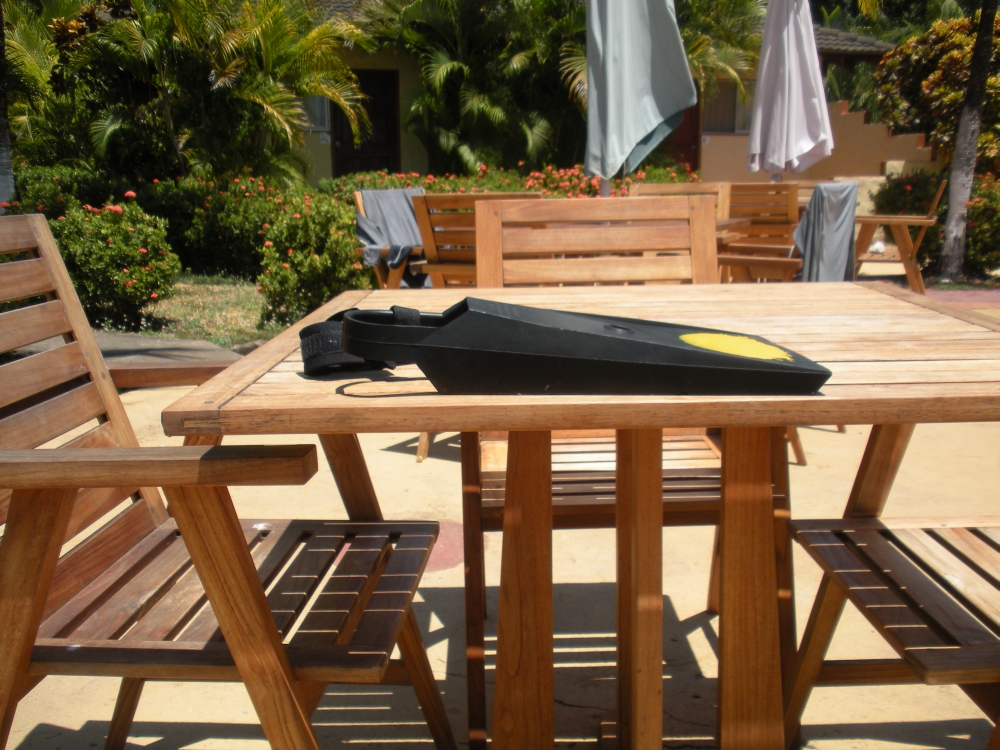
| A short note on the popular Yucca swim fins: These come in long and short blade styles and several flexiness/softness. The company seem to grade out the blade stiffness-flex/softness to thrust-comfort. The fins are very popular with an avid following. Advisory: the long blades have a small foot pocket entry--I couldn't even fit a fin on my foot 2 an 3 sizes up. A friend used a short blade version for a short while before they wrecked his feet and ankles and legs. As I always highly recommend: try before buy. The shape of our feet can differ quite a bit with various widths, toe patterns and arches. What might a great fit for one person can be a complete non-starter for another person. Likewise, once you obtain a well-fitting swim fin in the water you may discover it performs in ways you savor or detest. | 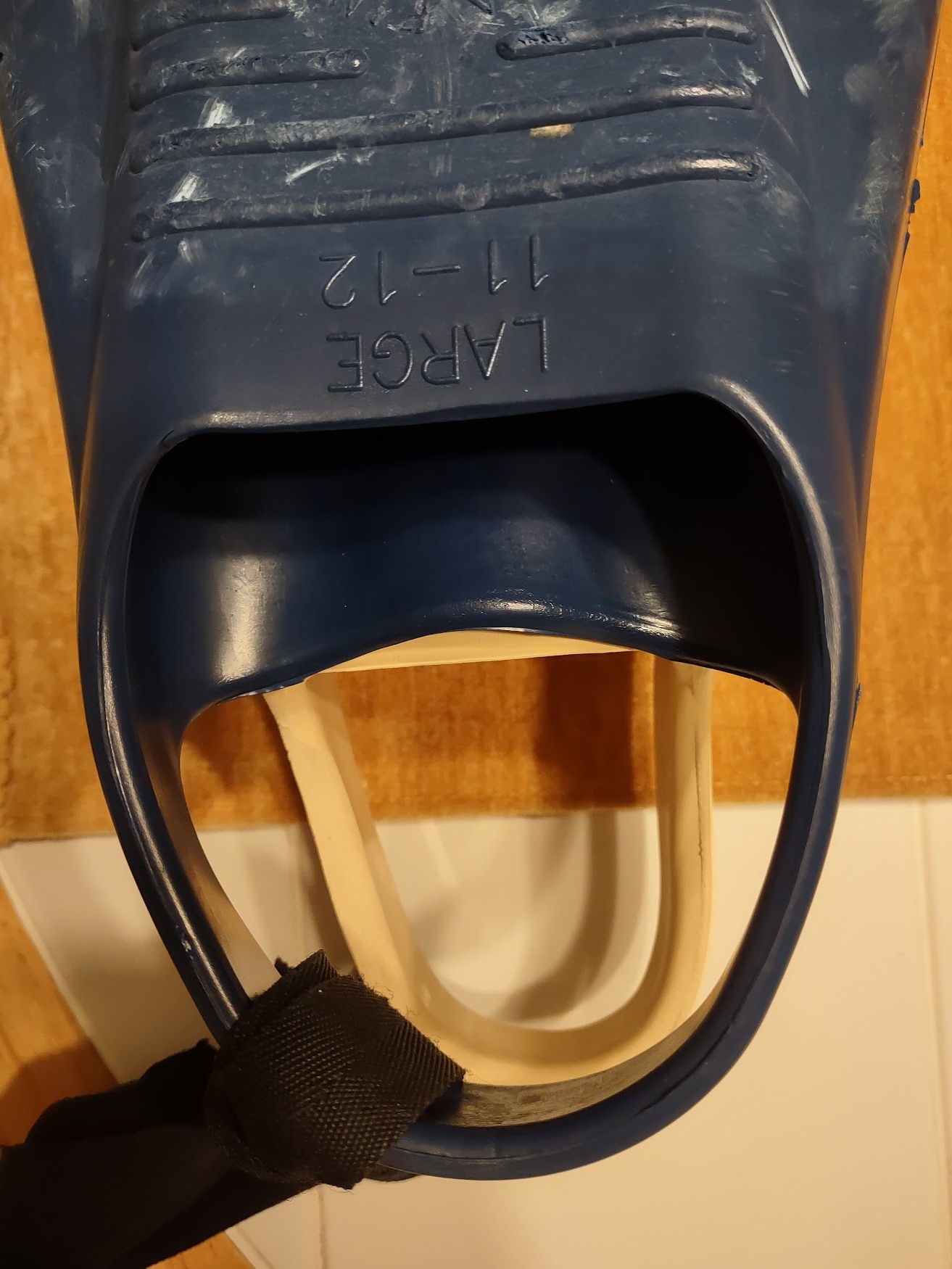 |
|
Notes on Other Items of Interest: Fin Socks, Fin Tethers and Fin Care |
||
| A good selection of surf fin accessories and discussion can
be found on eBodyboarding.com's site that I have reproduced
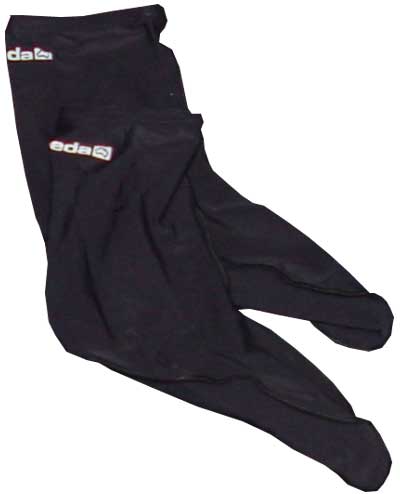
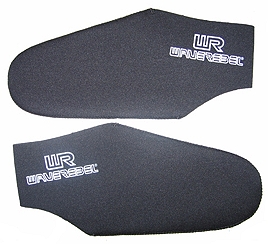
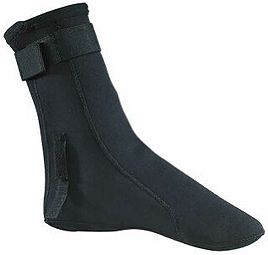
here. Here are my "a-b-c's" of fin accessories: Use fin socks for protection! For warm water wave riding, lycra fin socks should provide sufficient protection to keep your toes, feet and ankles from blistering. Sometimes you will need to move up to a heavier fin sock in warm water use that have open heals and are about .3mm to .5mm in thickness (thicker 1mm to 2mm models are also available but might make the fin too tight). Cool and cold water socks are made of the same materials you find in a wetsuit and are similar to ankle high socks. These wetsuit socks can be found in thicknesses ranging from 1mm to 5mm. Do NOT confuse wetsuit socks with booties. The booties' stiff soles will usually cause fitting problems with your fins (there are some exceptions, e.g., the strap over the foot fins made by Force Fins). Update 2025: About half-dozen years ago my standard toe-to-ankle length 2mm fin socks were wearing holes in the bottom as I was walking on pavement, sticky grass, goat trails, and hot beaches and didn't want to always be forced to wear flip-flops or sandals. The first thing I did while searching out fin socks with flexible but durable soles was to patch several pairs of my otherwise perfectly good fin socks. I used awning material, plastic gloves, AquaSeal+FD, small paint brush, masking tape, two thin wood slats, and small C-presses to do the job. I also identified NRS Sandal Socks as a good off-the-shelf solution (I wish they went over the ankle bone but they do okay). You can often find them at REI for sizing fit before purchasing. Also available on Amazon and other on-line stores. I swear by fin tethers! When I first started bodysurfing and paipo boarding in the overhead, crunching surf of Puerto Rico's west coast in the late 1960s there were not many options other than using tennis shoe laces (that and my girl friend's old nylons as a "lycra sock"), or losing fins. The last time I neglected to use fin tethers was early one Sunday morning at San Diego's Big Rock, a sucking left breaking on a shallow ledge reef. I took off on a fun 4-footer, lined up in the tube very nicely, but the furball in back ripped by flipper right off. With no extras in my surf bag and a late morning flight to catch I was without option! Never again! Fin tethers come in a wide variety of string and nylon loops, narrow and wide ankle wraps, and velcro and plastic snap closures. I prefer the nylon loop (less ankle rubbing), wide strap velcros. Preference will vary, but if you find yourself riding cold water waves in cold air temps then I highly recommend acquiring tethers with long ankle wraps and pull tabs. Why? In cold water you need to wrap the straps around many millimeters of wetsuit/socks and the tabs are for easy removal when your fingers are freezing. |
||
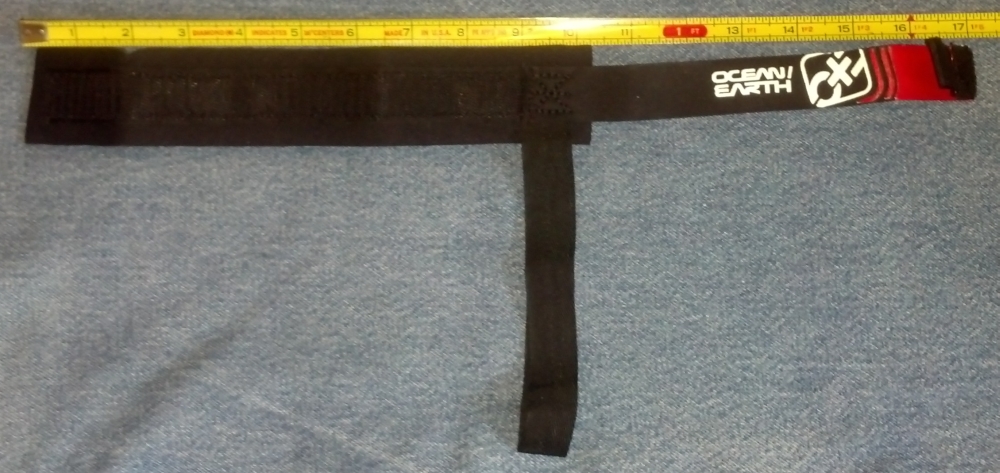 |
O&E Fin Tethers (Fin Savers) What I like about these fin tethers
|
|
|
The secret to long lasting fins is proper fin care. First and foremost, do not leave the fins exposed to the direct sun for extended periods of time as the heat and rays degrade the rubber and plastic fin material. Second, rinse the fins in fresh water after each salt water or chlorinated water use. The next recommendation I have never used before but it makes sense in the same way one cleans and treats an automobile's interior hardware to prevent cracking, color degradation, dry rot and to add softness and luster to the fins:
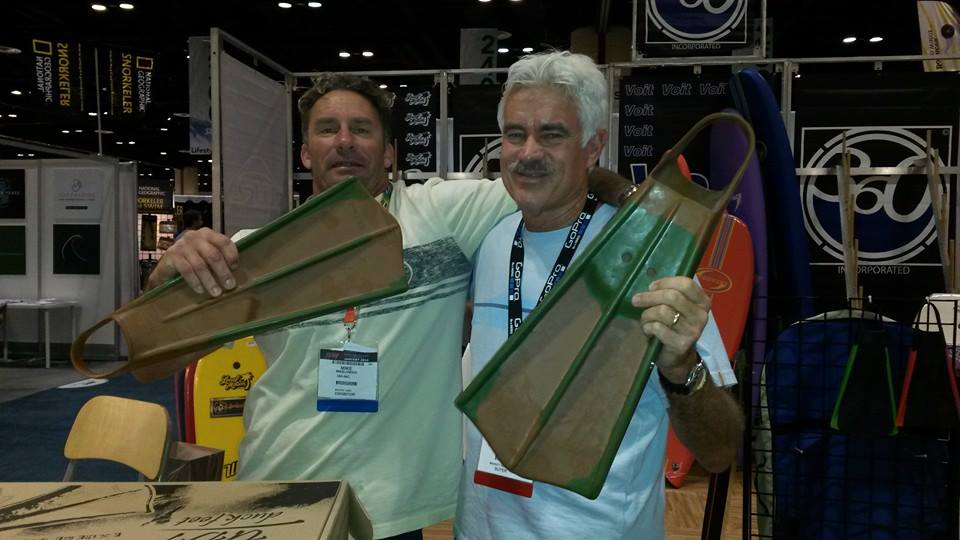
It might be frustrating finding your supplies at local surf shops. One good option is eBodyboarding.com and another is the river/kayak oriented company, NRS. Also, be sure to search the internet for your specialized needs. Need to Modify Your New Formulation DaFins? Review by John Hughes Last January at the Surf Expo I found out the DaFin had switched to making their fins with Maylaysian rubber. This is the same type of rubber used in the new UDTs and is supposed to be the best rubber in the world. I have been using DaFins for many years now and have been very happy with them. I have one pair of oversized fins which I use in the winter and another for wearing barefoot, which are the ones I use the most here in sunny Florida. I finally ordered a pair and was excited to test them out and see the difference with the new material. The previous compound has always worked well with plenty of power in a compact fin and a very comfortable foot pocket that I can wear for hours without a problem, other the two small pukas that they would consistently rub on my right foot. The new DaFins can be recognized by the "Made in Maylaysia" printed on the box. The fins themselves have no origin on them and the "Made in the USA" is no longer visible on the bottom of the foot pocket. The thing that is immediately noticeable is how soft and pliable the rubber is compared to the old DaFins. The foot pocket fits like a glove and when in use you can feel that the fin blade flexes more evenly across the length of the blade. The old fins would deflect sharply around the toe end of the pocket due to the blade being less pliable. It is not something that would be noticed if not compared to the new fins. Whether or not the new fins are more powerful is difficult to discern but they certainly feel as though they are. In that respect they are an improvement over the old ones. But here is the rub (literally). After a session in some head high swell that required some serious kicking these fins tore my feet up, leaving some nice scabs on both feet at the opening of the foot pocket. Needless to say, I was disappointed with this and I examined the old and new versions to figure out why this was happening. It became apparent the the new fins were not finished as well after popping out of the mold. I could see that the USA fins had a rounded radius on both the inside and outside edge and had also been hand sanded to de-burr the mold seam. On the new Maylaysian fin there is a sharp edge where the pocket contacts the foot, and the mold seam has been roughly cut away, leaving plenty of edges to wear my skin. Being the relentless tinkerer I am, I decided to come up with a fix for the problem. After some experimentation I decided to melt the sharp edges off using my propane torch and a metal spoon. I heated the spoon with the torch and when it was hot enough I ran the heated spoon over the edges until they melted into a smooth surface where they contact my foot. The plan worked well except for a sticky residue that was left behind. I was able to remove that with some isopropyl alchohol. I have to wait for the scabs to heal before I can know if this was a good fix. But I will give an update when that happens. |
|
UDTs Revisited, Update March 2014 (@ Aquatic Apes on Facebook.com) Review on Facebook by John Hughes. |
||
| I
went mat surfing w/ the new, improved UDT's this morning. This time in
better waves- waist+ high with some groundswell push behind it. I chose
to try them barefoot, fully expecting to be out of the water in ten
minutes with major foot pain. To my surprise the fins were very
comfortable and I was able to get a 1 1/2 hour session in with no
problems. The new, more flexible rubber compound is a major improvement in comfort and power. I was impressed with how quickly I was able to power through the shorebreak to the outside. Although they are still a burly fin, my feet and legs are adapting quickly and I anticipate being able to use them without cutting them down and customizing them. The only thing I had to do was add a strap pad to take up the slack without using booties. (March 2, 2014) |
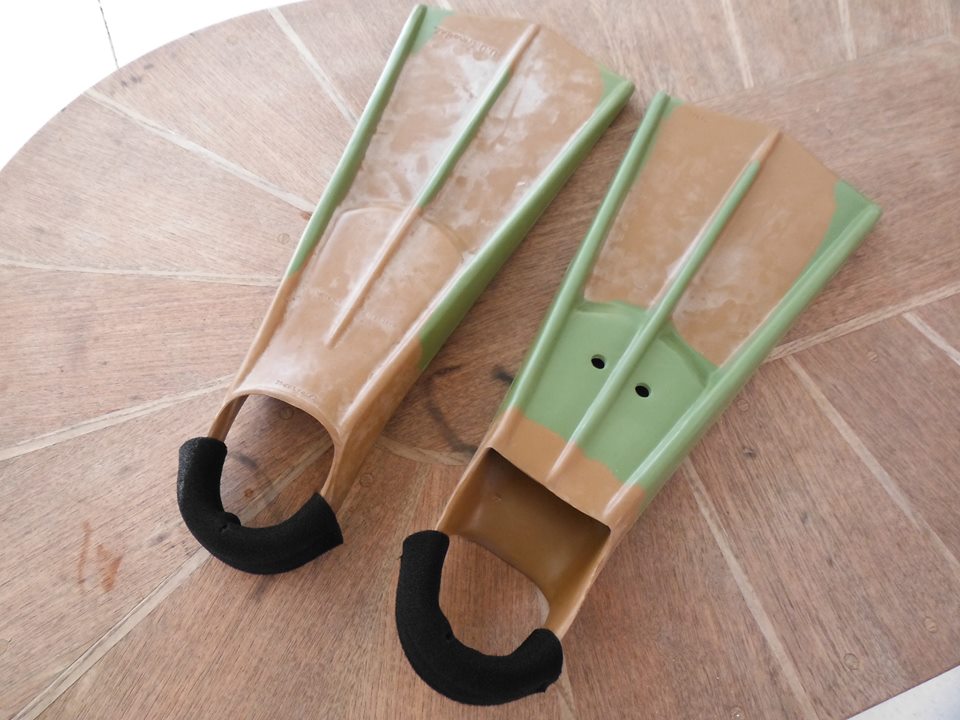 Additional comments and discussion at the Aquatic Apes group page in Facebook.com, (March 2, 2014) Post script: Those fins are toast, errr, modded. Learn more plus lessons learned from John's March 4, 2014, posting to Aquatic Apes. |
|
|
Modified UDT/DaFin Comparison Test: Surprising Results Review by John Hughes (March 20, 2014 @ Aquatic Apes on Facebook.com) |
||
| As
promised I did some performance tests on my newly modified UDT’s. For
comparison I switched between the UDT’s and DaFin’s, which I currently
use. My first session was on my 4GF Omni surfmat In 2-4 ft semi-clean
beachbreak surf. This was initially the only session I intended to do
but the results were so surprising, I felt I needed to do another test. To change the variables my next session was on an HPD paipo that I had borrowed from a friend, in 3-4 NE swell with some groundswell energy. In each case, I caught several waves on on the UDT’s and DaFin’s, paying close attention to 1) how quickly and easily I could make my way to the outside 2) how the fins compared when getting into waves. and 3) comfort. My conclusion in a nutshell: DaFin’s are a superior fin in every measure. |
||
|
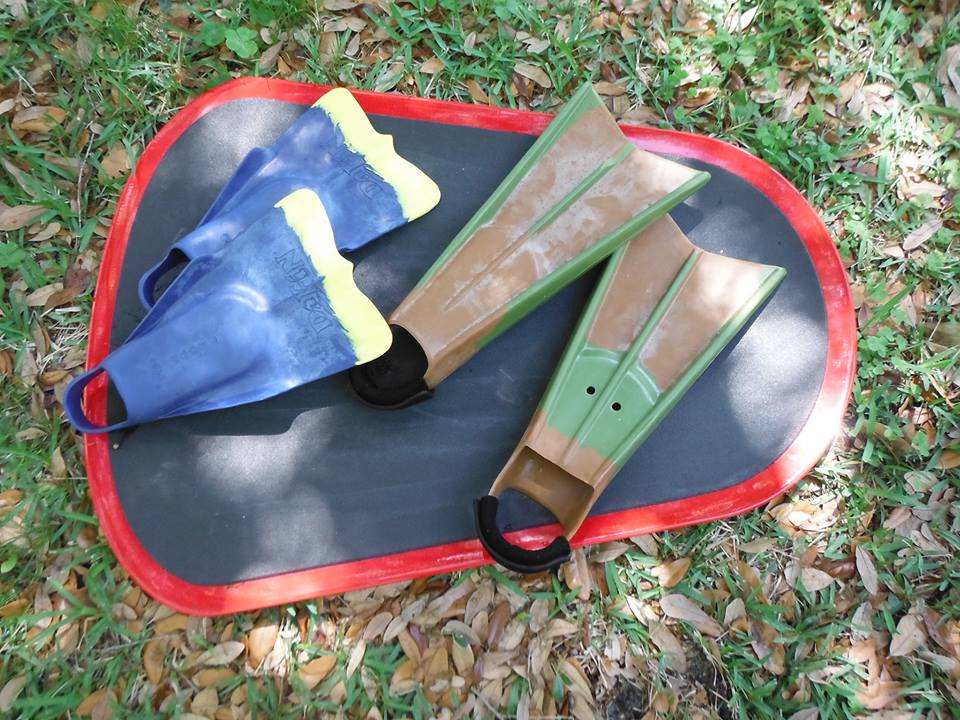 DaFins & Modified UDTs laying on an HPD. Photo by John Hughes. |
|
| My conclusion is that
DaFin’s are a superior fin because they are FAR MORE EFFICIENT than the
UDT’s. They provide the same or better performance with considerably
less energy expenditure. There are, of course, many fans of the UDT’s
and for them it is the best fin. These results are just my opinion
based on my experience. John Hughes on Facebook.com at the Aquatic Apes group page (March 20, 2014) Additional comments and discussion @ Facebook.com. |
||
|
Other users' random comments on fins:
The balance you want to look for in flippers (besides comfort of course) is between long distance cruising, i.e. paddling out and cruising the line-up, and acceleration/burst speed for spin and take off etc. Probably most mat surfers are using UDT's from Prof. Greg Deets. (parsimony@ earthlink.net), or Voit at 1-800-925-9283. Most people under 170 pounds or so cut them down following Greenough's modification. First flattening the ribs a bit then taking a little at a time off the length to hit their personal best compromise. You mlso many need to trim the strap a bit as they are very stiff overall and generally not too comfortable for most.
Posted: Oct 14, 2007 by DrStrange
Follow-Up on Loose Straps: Talked to John Piatt last night (Flips maker). He said to prevent this from happening adjust front strap and slide foot out. Fold extra length of strap toward toes and then back UNDER the strap and insert foot. Tighten upper strap to where you want it, unbuckle it and do the same with the extra length--fold it toward toes and then back under the strap and snap the buckle. This way, foot pressure on the loose end locks it in place.
|
|
Fins for the Styling Ladies? |
|
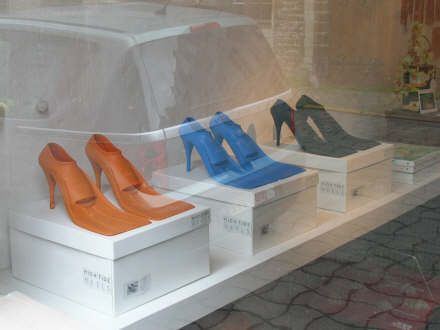 |
High-healed designer
flippers. Are gold fin tethers, matching nylon fin socks and mini-skirt
wetsuits included? |
|
Feel free to send me your own flippers/swim fin solutions and why they work for you. |